Alpine's hemp Farm to Cabinet
 FREE SHIPPING ON 2-3 DAY U.S.A. ORDERS 100% SATISFACTION GUARANTEE
The statements on the product labels have not been evaluated by FDA and the products are not intended to diagnose, treat, cure or prevent any disease or medical condition. The contents of this website are for informational purposes only and do not render medical or psychological advice, opinion, diagnosis, or treatment. The information provided through this website should not be used for diagnosing or treating a health problem or disease. It is not a substitute for professional care. If you have or suspect you may have a medical or psychological problem, you should consult your appropriate health care provider. Never disregard professional medical advice or delay in seeking it because of something you have read on this website. Any review or other matter that could be regarded as a testimonial or endorsement does not constitute a guarantee, warranty, or prediction regarding the outcome of any consultation. The testimonials on this website represent the anecdotal experience of individual consumers. Individual experiences are not a substitute for scientific research.
N O V E M B E R 2 0 2 0 | V O L . 1


CBD as a Superbug
Antibiotic?
"In every case, CBD had a very
similar potency to that of common
antibiotics." Page 2
Source: Institute for Molecular
Bioscience, University of Queensland,
Australia
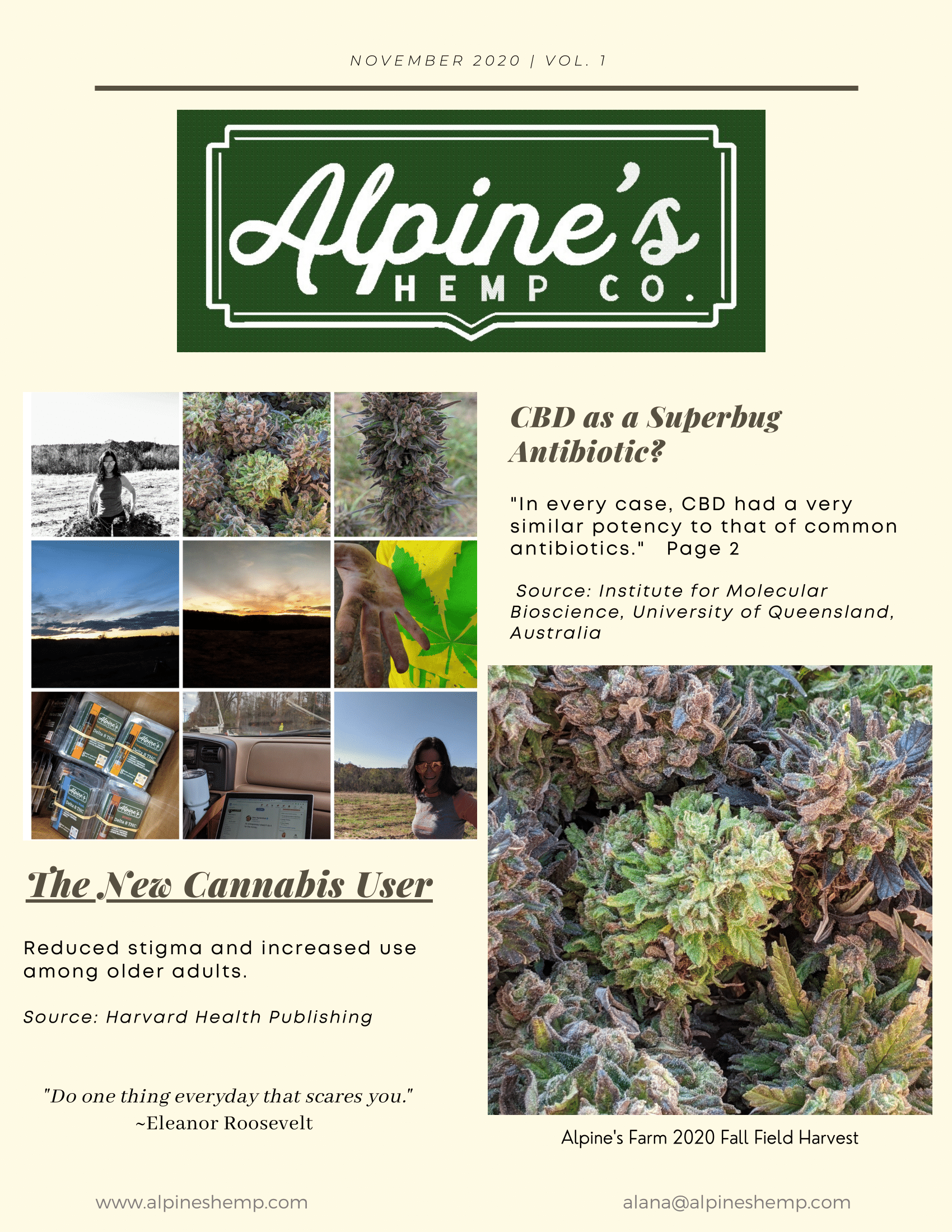
The New Cannabis User

Reduced stigma and increased use
among older adults.
Source: Harvard Health Publishing
"Do one thing everyday that scares you."
~Eleanor Roosevelt
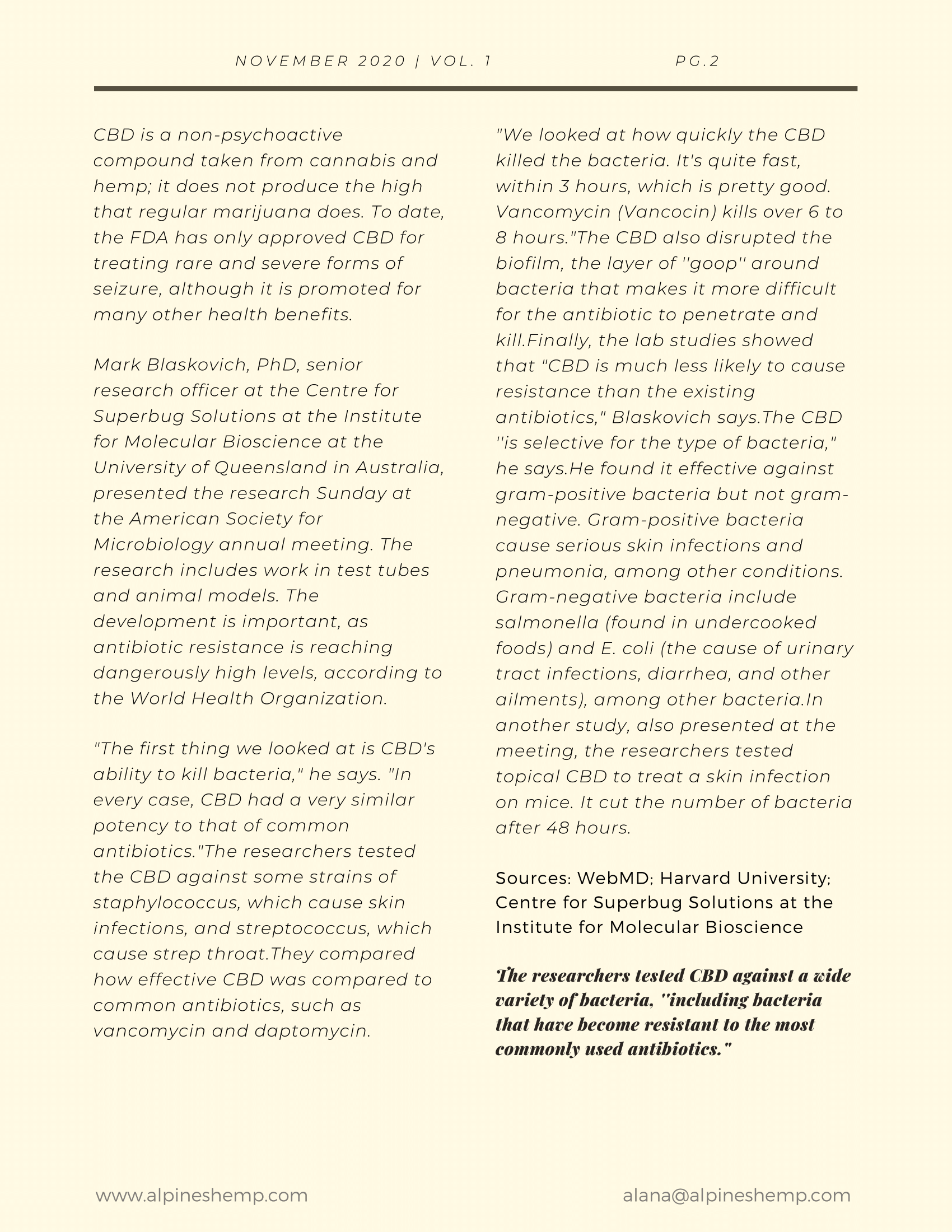
Alpine's Farm 2020 Fall Field Harvest
www.alpineshemp.com alana@alpineshemp.com
N O V E M B E R 2 0 2 0 | V O L . 1 P G . 3

Studies show ages range from people in
their 60s with kidney failure who can no
longer take certain pain medications but
still need to manage chronic pain, to
patients in their 90s, who are looking for a
good night’s sleep and are leery of the side
effects of traditional sleep medications.
The New Cannabis User
What might be behind this trend?
A convergence of factors seems to be responsible, including the decrease in stigma associated with cannabis use and the increased interest in the use of medical marijuana by older patients. Stigma is a complicated issue, but most would agree that the stigma associated with cannabis use is lessening, especially for medical cannabis. In a recent poll, 94% of Americans voiced support for legal access to medical marijuana, and most states have approved some form of legal access.
One marker for the decrease in stigma is the recent statement by the 38 million member AARP, in which they declared their support for the medical use of marijuana for older adults in states that have legalized it, in close consultation with their medical providers, where they can discuss the most up-to-date clinical evidence, weighing the balance of benefits and harms.
Interestingly, there is some research that cognitive functioning can actually improve when patients use medical cannabis, due to, among other things, improved sleep and pain control. It seems plausible that older patients might be using lower doses of pain and sleep medications, which can affect thinking, and they are combatting the negative effects of chronic pain and insomnia, which also have an effect on cognitive functioning. However, as with most things cannabis-related, this too needs further study to confirm and clarify.
Bottom Line
Cannabis use among the elderly is growing as there is more public acceptance and reduced stigma. Medical cannabis is increasingly viewed as an effective option for managing insomnia and chronic pain. It’s key to have an informed discussion with your doctor to weigh the safety risks, especially if you have cardiac issues, are taking multiple medications, or have cognitive changes due to aging. Educate yourself (and your doctor) as much as possible about cannabis before starting to use it. Most of the adverse effects associated with cannabis usage are dose-related, so it is important to know the strength of the marijuana you are taking and to “start low and go slow”: start with the lowest effective dose and take your time working your way up to a dose that alleviates your symptoms with a minimum of side effects.
www.alpineshemp.com alana@alpineshemp.com
N O V E M B E R 2 0 2 0 | V O L . 1 P G . 2
CBD is a non-psychoactive
compound taken from cannabis and hemp; it does not produce the high that regular marijuana does. To date, the FDA has only approved CBD for treating rare and severe forms of seizure, although it is promoted for many other health benefits.
Mark Blaskovich, PhD, senior research officer at the Centre for Superbug Solutions at the Institute for Molecular Bioscience at the University of Queensland in Australia, presented the research Sunday at the American Society for
Microbiology annual meeting. The research includes work in test tubes and animal models. The
development is important, as antibiotic resistance is reaching dangerously high levels, according to the World Health Organization.
"The first thing we looked at is CBD's ability to kill bacteria," he says. "In every case, CBD had a very similar potency to that of common
antibiotics."The researchers tested the CBD against some strains of staphylococcus, which cause skin infections, and streptococcus, which cause strep throat.They compared how effective CBD was compared to common antibiotics, such as vancomycin and daptomycin.
"We looked at how quickly the CBD killed the bacteria. It's quite fast, within 3 hours, which is pretty good. Vancomycin (Vancocin) kills over 6 to 8 hours."The CBD also disrupted the biofilm, the layer of ''goop'' around bacteria that makes it more difficult for the antibiotic to penetrate and kill.Finally, the lab studies showed that "CBD is much less likely to cause resistance than the existing
antibiotics," Blaskovich says.The CBD ''is selective for the type of bacteria," he says.He found it effective against gram-positive bacteria but not gram negative. Gram-positive bacteria cause serious skin infections and pneumonia, among other conditions. Gram-negative bacteria include salmonella (found in undercooked foods) and E. coli (the cause of urinary tract infections, diarrhea, and other ailments), among other bacteria.In another study, also presented at the meeting, the researchers tested topical CBD to treat a skin infection on mice. It cut the number of bacteria after 48 hours.
Sources: WebMD; Harvard University; Centre for Superbug Solutions at the Institute for Molecular Bioscience
The researchers tested CBD against a wide variety of bacteria, ''including bacteria that have become resistant to the most commonly used antibiotics."
www.alpineshemp.com alana@alpineshemp.com